
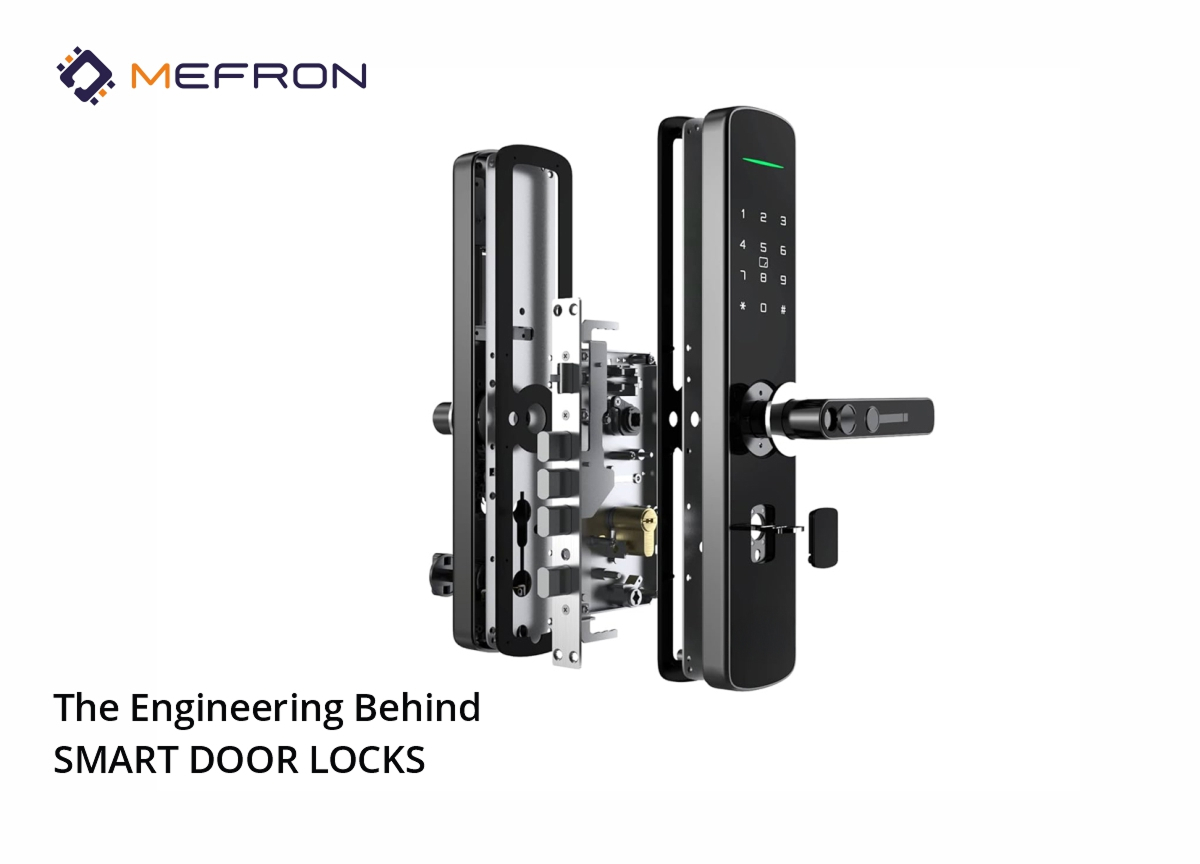
Smart door locks represent a tightly constrained engineering system in which embedded electronics and sensors, RF communication modules, power management and mechanical actuation must function seamlessly within a limited space and with limited energy. While many products reach the prototype stage successfully, failures often occur during real-world deployment due to insufficient engineering depth.
This is where a precision-driven ODM approach, such as Mefron's, becomes critical, ensuring that engineering decisions are made not just for functionality but also for scalability, reliability, and manufacturability.
Ensuring Deterministic Performance Through Embedded Architecture
A smart lock operates in an event-driven environment where inputs such as biometric authentication, BLE communication, and motor actuation occur asynchronously. The system must respond in real time without latency variation.
In simpler designs, a bare-metal architecture can manage limited workloads efficiently. However, as features expand to include Wi-Fi, OTA updates, and multi-user access control, an RTOS-based architecture becomes essential. It enables prioritization of time-critical operations while maintaining system stability under concurrent processing loads.
Optimizing Power Systems for Real-World Usage Conditions
Power architecture in smart locks is defined by extremes including ultra-low standby consumption and high current bursts during actuation. Poor handling of these transitions often leads to field failures such as random resets or rapid battery depletion.
A robust design integrates efficient power regulation, transient handling, and battery-aware system behaviour. This includes managing voltage drops during motor activation and ensuring stable operation across battery life cycles.
Connectivity Engineering in Constrained Enclosures
Unlike typical IoT devices, smart locks operate in RF-constrained environments, often mounted on metal doors that degrade signal performance. This makes antenna design and RF tuning a critical engineering challenge rather than a secondary consideration.
Protocol selection further impacts system behaviour. BLE offers low power operation, while Wi-Fi enables remote access but introduces thermal and energy overheads. The design must balance these trade-offs based on application requirements.
Build Your Smart Lock With a Precision ODM Partner
End-to-End Security Architecture in Smart Locks
In smart locks, firmware security directly impacts physical safety. A secure architecture must ensure that only authenticated firmware is executed, communication channels are encrypted, and updates are protected against tampering.
This requires integration of secure boot mechanisms, encrypted storage, and robust OTA frameworks. However, implementing these without overloading system resources is a key engineering challenge.
Precision Mechatronics for Consistent Locking Performance
Mechanical inconsistencies in door alignment and installation introduce variability that purely electronic systems do not face. The actuation system must adapt to these variations while maintaining efficiency and durability.
This involves intelligent motor control, stall detection, and feedback-driven actuation strategies. Without these, systems risk incomplete locking cycles and increased wear.
Manufacturing-Driven Design Optimization in Smart Locks
A design that performs well in isolation may fail during mass production if manufacturing constraints are not considered early. Component selection, PCB layout, and assembly design all influence production yield and cost.
Conclusion
Smart door lock engineering is defined by the ability to manage constraints across multiple domains simultaneously. Success depends on anticipating real-world conditions, optimizing system interactions, and designing for scale from the outset, forming a critical part of the overall development journey from concept to mass production in smart door lock ODM.
Mefron's ODM model brings together in-house R&D, precision engineering, and manufacturing expertise, ensuring that products are not only functional but robust, scalable, and production-ready.