
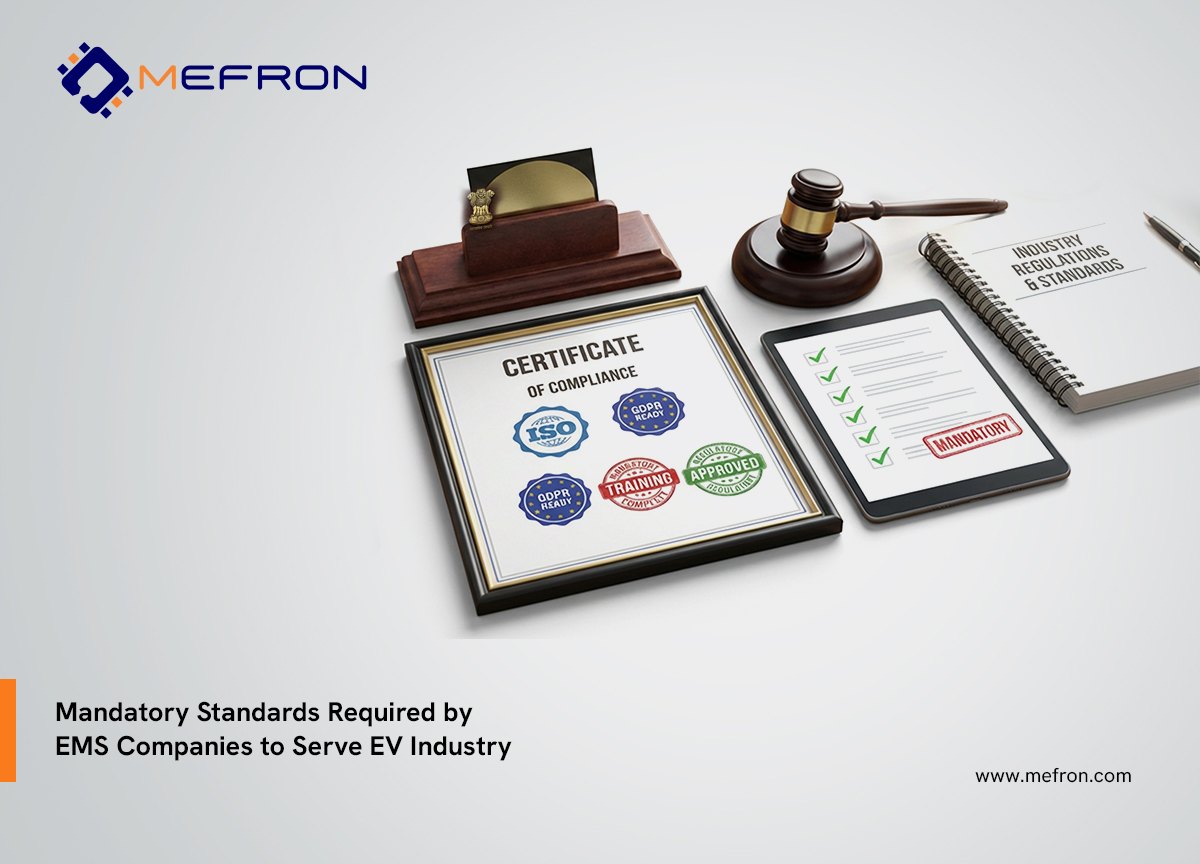
Certifications and compliance are not just documents; they are instruments for protecting lives and property by ensuring that everyday products are safe for families and communities. Electrical short circuits account for a large share of global fire incidents, many of which can be prevented through mandatory compliance at the manufacturing level, covering not only products, but entire processes.
India's EV industry surges forward, powered by EMS companies delivering PCB assembly, wire harnessing, cable assembly, box-build solutions for battery packs, turnkey manufacturing, and Battery Management Systems (BMS). Every component installed in final EVs demands certification for safety. Government mandates like AIS-038, PESO, and AIS-156 ensure Electronic Manufacturing Services meet these critical standards.
Why Compliance is Critical for Indian EMS Companies
EV electronics operate under high-voltage, high-current, and harsh environmental conditions. Any failure can directly impact vehicle safety and regulatory approval. Certifications ensure that EMS companies:
- Meet automotive-grade quality expectations
- Comply with Indian and global regulations
- Maintain traceability and process control
- Qualify for OEM and Tier-1 supplier audits
- Reduce product liability and recall risks
For Indian EMS companies aiming to move from consumer electronics to EV and automotive programs, compliance is often the biggest qualification gap.
Would Like to Connect With Our Sales Representative
Core Quality & Automotive Certifications
Certification & Compliance Matrix for EMS Companies (EV Focus)
| Name | Use/Purpose | Type | Applicability |
|---|---|---|---|
| ISO 9001 | Establishes a structured Quality Management System to ensure consistent manufacturing, documentation, and corrective actions | Certification | Global |
| IATF 16949 | Ensures automotive-grade quality, defect prevention, traceability, and compliance with OEM requirements | Certification | Global |
| ISO 14001 | Manages environmental impact through waste control, chemical handling, and energy monitoring | Certification | Global |
| ISO 45001 | Provides a framework for occupational health and safety, especially for high-voltage and battery-related operations | Certification | Global |
| AIS Standards (AIS-038, AIS-048, AIS-156) | Define EV safety, construction, powertrain, and battery safety requirements | Compliance | India |
| BIS & CRS | Ensures products meet Indian safety and performance standards under Compulsory Registration Scheme | Compliance | India |
| IEC Standards (62133, 61851, 60664) | Define international electrical safety, insulation, battery, and EV charging requirements | Compliance | Global |
| UL Compliance | Validates product safety for North American markets | Compliance | North America |
| RoHS | Restricts hazardous substances in electronic assemblies | Compliance | Global |
| REACH | Regulates chemical substances and SVHC disclosures for EU-bound products | Compliance | Europe |
1. ISO 9001 - Quality Management System
Status: Mandatory baseline
ISO 9001 is the minimum requirement for any EMS company supplying EV-related electronics in India.
It ensures:
- Controlled manufacturing processes
- Documented quality systems
- Corrective and preventive actions
ISO 9001 is not only for automotive EV programs, it is a QMS certificate for each & every industry.
2. IATF 16949 - Automotive Quality Management System
It is mandatory for automotive-grade EV components. IATF 16949 is essential for Indian EMS companies supplying:
Automotive PCB Assembly:
- BMS and battery electronics
- Motor controllers and inverters
- ADAS and telematics modules
OEMs typically mandate IATF 16949 for:
- Production programs
- Safety-critical assemblies
- High-volume EV platforms
The standard emphasizes APQP, PPAP, FMEA, traceability, and defect prevention, areas closely audited during OEM supplier qualification.
Environmental, Safety & Workforce Compliance
3. ISO 14001 - Environmental Management System
With EV positioned as a sustainable alternative, OEMs expect suppliers to follow environmentally responsible manufacturing practices.
ISO 14001 covers:
- Waste and effluent management
- Chemical handling
- Energy consumption monitoring
- Environmental risk control
For Indian EMS companies targeting global OEMs, ISO 14001 is often a supplier onboarding requirement.
4. ISO 45001 - Occupational Health & Safety
EV electronics manufacturing involves high voltage testing, battery handling, and power electronics. ISO 45001 demonstrates structured safety practices and risk mitigation for shop-floor operations. It is one of the mandatory certificates an EMS must have.
Indian EV Regulatory & Product Standards
5. AIS Standards (India-Specific)
Automotive Industry Standards (AIS), issued by ARAI and ICAT, define safety and performance requirements for EVs.
Key AIS standards relevant to EMS companies include:
- AIS-038 - EV construction and safety
- AIS-048 - Electric powertrain requirements
- AIS-156 - Battery safety and thermal runaway protection
While certification is granted at vehicle or system level, EMS companies must ensure assemblies meet design and validation expectations aligned with these standards.
6. BIS & CRS Compliance
Under the Compulsory Registration Scheme (CRS), certain EV chargers, power supplies, and electronic sub-assemblies must be registered with the Bureau of Indian Standards (BIS).
Indian EMS companies manufacturing:
- EV chargers
- Power adapters
- Control units
Must ensure products conform to applicable IS standards.
International Standards Relevant to Indian EMS Export Programs
7. IEC Standards
IEC standards apply to electrical safety and performance, especially for EV charging systems and power electronics.
Commonly referenced standards:
- IEC 62133 - Battery safety
- IEC 61851 - EV charging systems
- IEC 60664 - Insulation coordination
Indian EMS companies supplying export-oriented EV programs must align testing and documentation with IEC requirements.
8. UL Compliance (Export-Focused)
Status: Mandatory for North America. UL compliance is required for EV components exported to the US and Canada, particularly for:
- Battery packs
- BMS
- Power conversion units
- Charging infrastructure
EMS companies must manufacture products capable of passing UL safety evaluations, even if certification is held by the OEM.
Material & Chemical Compliance
9. RoHS Compliance
RoHS restricts hazardous substances in electronic assemblies and is mandatory for both Indian and export markets.
EMS responsibilities include:
- RoHS-compliant component sourcing
- Supplier declarations
- Material traceability
10. REACH Compliance
REACH governs chemical substances used in electronics manufacturing. Indian EMS exporters must maintain SVHC disclosures and compliance documentation for EU-bound products. This certification is mandatory for Europe
Process-Level Compliance Expected by EV OEMs
Beyond formal certifications, Indian EV OEMs audit EMS companies on process maturity, including:
- Component and batch traceability
- ESD control (ANSI/ESD S20.20)
- High-voltage and functional testing
- Reliability testing (thermal cycling, vibration, burn-in)
- Engineering change and deviation management
Many supplier rejections occur due to weak process control rather than missing certificates.
Key Compliance Challenges for Indian EMS Companies
- High cost of IATF 16949 implementation
- Rapidly evolving EV safety standards
- Managing compliance across domestic and export markets
- Upgrading legacy consumer electronics processes to automotive-grade systems
Addressing these challenges early improves OEM trust and long-term program stability.
5 Challenges OEMs and EMS Must Address Before Signing a Contract
Conclusion
Every Indian EMS company must invest in certifications, compliance, and regulatory alignment to effectively support the EV industry, where safety requirements are significantly more stringent due to the high risk associated with electrical and battery systems. Compliance with mandated standards not only reduces incidents but also builds long-term trust with OEMs and regulatory authorities.
EMS providers that systematically follow certification guidelines and regulatory frameworks are better positioned to serve EV manufacturers reliably. Selecting an EMS partner with proven compliance capabilities is therefore a critical decision for any EV company operating in this sector.