
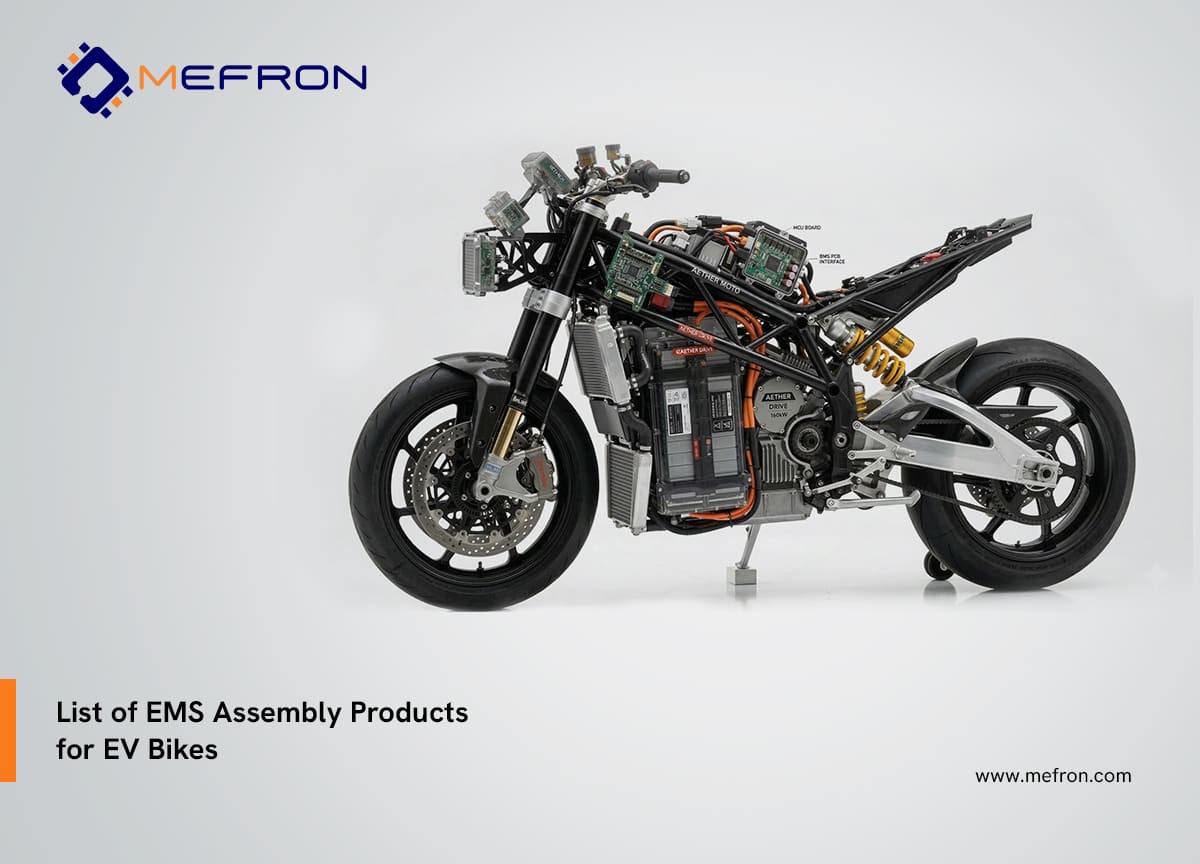
A modern-day EV bike does not just run; it performs multiple functions simultaneously. To manufacture a complete EV bike, various sub-systems and components must be assembled and integrated in a precise manner so that the final product performs all intended functions reliably. It would be practically impossible for all these components to be manufactured at a single location.
Different parts are manufactured or assembled at different facilities. For example, PCB assembly may be carried out at one location, while plastic injection molding is done at another. As a result, OEMs often need to engage with multiple EMS companies for different parts and assemblies. Any delay, quality issue, or mismanagement from even one EMS partner can significantly impact the OEM's business. They cannot ship a bike to the showroom if even a single component, such as an indicator glass, is missing.
However, as the Indian EMS industry continues to expand, many EMS companies have taken the initiative to offer complete box build assembly solutions. Under this model, EMS partners take responsibility for building full enclosures such as battery packs, MCUs, and other integrated assemblies, along with plastic injection molding, PCB assembly, wire harnessing, and related manufacturing services.
The biggest advantage for OEMs is the reduced dependency on multiple EMS vendors. By working with fewer, more capable partners, OEMs can save considerable time in final assembly and overall production planning. This integrated approach enables EV manufacturers to respond faster to market demand and outpace competitors by partnering with a reliable EMS company.
List of Electronic Manufacturing Service Products for EV Bikes
1. Battery Management System (BMS)
The Battery Management System is the "brain" of the EV bike's battery pack.
Function
- Monitors cell voltages, pack temperature, and state of charge (SoC).
- Balances cells to maximize life and capacity.
- Protects against overcharge, overdischarge, overcurrent, and thermal runaway.
Technical Highlights
- High-current sensing circuits and insulated high-voltage interfaces.
- Integrated communication (CAN/LIN) for vehicle control units.
- Rugged enclosure with IP67 sealing for environmental protection.
Why EMS Value Matters:
Our box build integrates precision sensors, high-reliability PCBs, thermal management, and rugged housings; all compliant with automotive standards, ensuring safety and long service life.
2. Motor Control Unit (MCU) Box
Function
The Motor Control Unit manages power delivery from the battery to the electric motor.
Technical Highlights
- High-speed microcontroller or DSP for real-time control.
- Power electronics with insulated gate bipolar transistors (IGBTs) or MOSFETs.
- Feedback interfaces for torque, speed, and rotor position.
Capability Showcase:
Our assembly includes precision power electronics, heat-sink integration, and EMI/EMC shielding to withstand automotive electrical environments.
3. DC-DC Converter
Function
Converts high-voltage battery output (e.g., 48V-400V) to low-voltage systems (12V/24V) for auxiliary electronics.
Technical Highlights
- Switching regulators with high conversion efficiency (>90%).
- Overcurrent and overtemperature protection.
- Compact metal enclosures for thermal management.
EMS Advantage:
It includes board mounting, connector harnessing, and thermal design, reducing development risk for OEMs.
4. On-Board Charger (OBC) Unit
Function
Handles AC to DC conversion for battery charging and communicates with charging stations.
Technical Highlights
- Power factor correction (PFC) circuitry.
- Compliance with SAE J1772 / IEC 61851 standards.
- Safety isolation and leakage detection.
Our Strength:
Integration of power components with safety interlocks, enclosures, and firmware provisioning minimizes field failures.
Would Like to Connect With Our Sales Representative
5. Instrument Cluster & Display Module
Function
Provides real-time information to riders, including speed, remaining range, battery status, and fault alerts.
Technical Highlights
- TFT or LCD with touch or button interface.
- CAN/CAN-FD connectivity.
- Light and temperature sensors for adaptive display.
EMS Benefit:
We offer assembly with precision displays, environmental sealing, and software-ready integration, easing OEM calibration efforts.
6. Lighting Control Module (LCM)
Function
Controls EV bike lighting like headlights, taillights, turn indicators, and auxiliary LEDs; based on user input and vehicle state.
Technical Highlights
- PWM dimming for energy efficiency.
- Diagnostic reporting via vehicle network.
- Robust connectors and automotive-grade passive components.
Why It Matters:
Functional box builds include harnessing and conformal coating for moisture resistance.
7. Telematics & Connectivity Box
Function
Enables GPS tracking, OTA updates, and remote diagnostics, forming the backbone of connected EV services.
Technical Highlights
- LTE/5G module integration.
- GNSS and antenna systems.
- Secure storage and encryption modules.
EMS Edge:
Our assembly supports shielding, antenna placement optimization, and testing for RF performance which is critical for reliable connectivity.
8. Throttle & Brake Sensor Assembly
Function
Senses rider inputs like throttle position and regenerative braking signals to translate them into control signals for the motor controller.
Technical Highlights
- Hall effect sensors or potentiometric sensors.
- Redundant signal paths for safety.
- Compact, sealed enclosure for water and dust resistance.
Added Value:
Custom mechanical housings and precision sensor calibration in factories reduce field variability.
9. Thermal Management Control
Function
Manages cooling systems like fans, pumps, and coolant valves to maintain optimal battery and power electronics temperatures.
Technical Highlights
- Temperature sensor interfaces.
- High-current relay drivers.
- Diagnostic and fault management logic.
EMS Integration:
It includes robust connectors and thermal interface materials for efficient heat transfer.
10. High-Voltage Junction Box (HVJB)
Function
Serves as a centralized distribution point for high-voltage power between battery, motor, OBC, and DC-DC converter.
Technical Highlights
- Insulated busbars and fuse holders.
- Contactors with arc suppression.
- Safety interlocks and service disconnects.
Why EMS Is Critical:
Precision assembly ensures electrical safety, creepage/clearance compliance, and reliable power distribution under vibration and temperature extremes.
11. Safety & Diagnostics Box
Function
Provides a centralized diagnostic and safety node, monitoring critical vehicle parameters and initiating protective shutdowns when necessary.
Technical Highlights
- Fault logging and event storage.
- Redundant communication pathways.
- Watchdog and fail-safe mechanisms.
EMS Added Value:
Manufactured to automotive reliability standards with traceable testing, reducing integration risk for OEMs.
12. Auxiliary Power & Accessory Box
Function
Delivers power to non-propulsion systems like infotainment, charging ports, cabin accessories, etc.
Technical Highlights
- Multiple output rails with protectors.
- Soft-start and surge protection circuits.
- Bus multiplexing for system control.
EMS Value:
Complete harnessing, enclosure sealing, and labeling simplify downstream integration.
Why Electric Vehicles OEMs Choose Professional EMS Partners
Fixing every wire and tightening every nut and bolt to assemble a complete EV bike requires significant infrastructure, skilled manpower, and a well-defined assembly process. Beyond physical infrastructure, OEMs also need process discipline to ensure that every bike delivered to the showroom is uniform in quality, performance, and reliability.
To address these challenges, OEMs increasingly rely on box build assembly, where individual sub-assemblies are designed and integrated to perform one complete function or multiple related functions. This approach reduces the number of individual parts involved in final assembly and significantly shortens overall assembly time. A box build assembly solution involves the complete integration of electronic, mechanical, and electromechanical components within a single enclosure.
Recognizing this industry requirement, some EMS companies, such as Mefron Technologies, have invested in dedicated facilities and capabilities to provide box build assembly services. These facilities are designed to support the growing needs of the EV industry in India by enabling scalable, consistent, and efficient production.
1. End-to-End Integration
From PCB design and assembly to enclosure selection, wire harnessing, mechanical fixtures, and final functional testing; we handle system-level integration under one manufacturing roof.
2. Automotive-Grade Quality & Compliance
Products for EV applications must adhere to stringent standards for vibration, temperature, moisture, and electrical safety. We design and test products to meet relevant automotive and EV safety standards.
3. Scalability & Supply Chain Resilience
With established supplier relationships and logistics planning, we support scale-up from prototype to mass production, optimizing cost without sacrificing reliability.
4. Design for Manufacturing (DFM) Expertise
Our engineers review product designs to improve manufacturability, reduce assembly complexity, and enhance field reliability for translating into faster time-to-market.
5. Comprehensive Validation & Testing
Every product undergoes functional testing, burn-in, environmental stress screening, and automated inspection (AOI/X-ray where needed), ensuring consistency and durability.
India's Leading EMS Companies
Conclusion
In today's competitive EV landscape, success depends on speed, quality, and the ability to scale efficiently. Box build assembly helps OEMs simplify manufacturing, reduce time to market, and achieve uniformity across production batches. Partnering with an experienced EMS company allows EV manufacturers to access mature processes, skilled manpower, and integrated manufacturing capabilities without the burden of developing large-scale infrastructure.
Indian EMS companies such as Mefron Technologies have invested in facilities and systems to support turnkey assembly solutions for EV applications, including battery packs, motor control units, and safety assemblies. With manufacturing responsibilities handled by a capable partner, OEMs can focus on innovation, branding, and market growth while maintaining control over product quality and performance.
For EV manufacturers aligned with the Make in India vision, choosing the right EMS partner is not just an operational decision, but a strategic step toward sustainable and competitive growth.